




This guide covers what coconut sugar actually is, how it's made, what it tastes like, how to cook and bake with it, and why it's become the ingredient we've built our entire sweet range around at The Coconut Sugar Company.
What Is Coconut Sugar?
Coconut sugar is a natural sweetener made from the sap of coconut palm flower buds. Despite the name, it doesn't come from coconuts. It comes from the palm tree itself.
Here's the process: a farmer climbs a coconut palm, makes a small cut in the flower bud, and collects the sap that drips out into a container. This sap, called "neera", is a sweet, slightly cloudy liquid. It's then heated in large open pans over a wood fire until the water evaporates and the sap crystallises into golden-brown granules.
That's the entire production process. No bleaching, no chemical refining, no centrifuging. Sap from tree, heated in a pan, becomes sugar. It's been made this way in Southeast Asia and Southern India for centuries.
What Does Coconut Sugar Taste Like?
The most common reaction from people trying coconut sugar for the first time: "This doesn't taste like coconut at all."
It doesn't. Coconut sugar has a rich caramel-toffee flavour with a slight butterscotch warmth. Think of it as brown sugar's more interesting, less molasses-heavy relative. The sweetness is round and deep rather than sharp and one-dimensional like white sugar.
This flavour profile is what makes coconut sugar so versatile. It works in tea and coffee (adding warmth rather than just sweetness), in baking (adding depth to cakes, cookies, and brownies), and most notably in Indian sweets, where the caramel notes pair beautifully with cashews, almonds, cardamom, rose, and sesame.
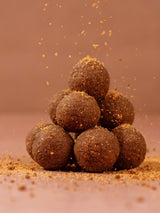
Our entire range of coconut sugar sweets is built on these natural flavour pairings. The Caramel Bites, for instance, get their deep toffee flavour from the natural caramelisation of coconut sugar during preparation — with no added caramel flavouring.
How Coconut Sugar Is Made: From Tree to Table
The Farming
Coconut sugar production is still largely a small-farm operation, particularly in Southern India where we source ours. A typical farmer might tend 20-30 coconut palms, climbing each one daily, sometimes twice daily, to collect fresh sap.
The farming families we work with in rural Southern India have been producing coconut sugar for generations. The skill involved isn't obvious until you watch it. Knowing which buds to tap, how deep to cut, when the sap is at its sweetest — this is knowledge passed from parent to child over decades.
The Processing
Fresh coconut palm sap spoils quickly in tropical heat. Within hours of collection, it's brought to a processing area and poured into large, shallow pans set over a controlled fire.
The sap is heated and stirred continuously for 1-2 hours as the water evaporates. Gradually, the thin liquid thickens into a syrup, then a paste, and finally begins to granulate. The moment it hits the right consistency, it's removed from heat and stirred rapidly until it cools into the familiar golden-brown granules.
Temperature and timing are everything. Too much heat and the sugar burns, becoming bitter. Too little and it won't crystallise properly. This is artisanal work. Each batch is judged by eye, by feel, and by the sound it makes in the pan.
Quality Variations
Not all coconut sugar is the same. The flavour, colour, and texture vary based on the species of palm, the soil it grows in, the season (dry season sap is sweeter), and the skill of the person processing it.
Cheaper coconut sugar is sometimes blended with regular palm sugar or even cane sugar to reduce cost. When buying coconut sugar, look for products that state "100% coconut sugar" or "100% coconut palm sugar" with no additives. Our coconut sugar contains nothing but crystallised coconut palm sap.
Cooking and Baking with Coconut Sugar
The 1:1 Swap Rule
In almost every recipe, you can replace white sugar with coconut sugar at a 1:1 ratio. One cup of white sugar = one cup of coconut sugar. The granule size is similar enough that measurements work out the same.
A few adjustments to keep in mind:
Colour: Coconut sugar is golden-brown, so your baked goods will be darker. A white frosting becomes tan. A vanilla cake looks more like a spice cake. This doesn't affect flavour, just appearance.
Moisture: Coconut sugar has a slightly lower moisture content than white sugar. In very dry recipes (like shortbread or meringue), you might notice a slight difference in texture. Adding a teaspoon of milk or a splash of vanilla extract compensates.
Sweetness level: Most people find coconut sugar tastes slightly less sweet than white sugar, but its caramel depth makes it feel richer. Start with a 1:1 swap and adjust to your preference from there.
Where Coconut Sugar Works Best
Indian sweets: This is our speciality, and for good reason. The caramel-toffee notes of coconut sugar amplify the flavours of traditional Indian sweet ingredients: cashews, almonds, pistachios, cardamom, rose, saffron, sesame. Every sweet in our collection demonstrates this.
Chai and coffee: Coconut sugar transforms a daily cup of chai. The caramel warmth interacts with chai spices (ginger, cardamom, cinnamon) in a way white sugar never does.
Cookies and brownies: The toffee notes make chocolate chip cookies and brownies taste noticeably richer. This is probably the easiest baking swap you can make.
Marinades and stir-fries: In savoury cooking, coconut sugar works anywhere you'd add a pinch of sugar for balance. It pairs especially well with soy sauce, tamarind, ginger, and lime.
Caramel and toffee: Making caramel with coconut sugar intensifies the flavour dramatically. It's already halfway to caramel before you even start cooking.
Where White Sugar Might Be Better
There are a few situations where white sugar is the better choice:
Delicate meringues and angel food cake: Where pure white colour and very specific sugar crystal behaviour matter, white sugar is more predictable.
Clear syrups: If you need a clear, colourless sugar syrup (for cocktails or certain confections), coconut sugar will produce a dark amber syrup instead.
Candy making at precise temperatures: Hard candy and pulled sugar work requires very pure sucrose. Coconut sugar's composition makes it less predictable at extreme temperatures.
Coconut Sugar vs Other Sweeteners
Coconut sugar vs white sugar: Different production, different flavour (caramel vs neutral), same basic use in cooking.
Coconut sugar vs jaggery (gur): Both are less processed than white sugar, but they taste quite different. Jaggery has a heavy molasses flavour. Coconut sugar is lighter and more caramel-forward. In sweets, coconut sugar produces a more refined, less earthy result.
Coconut sugar vs palm sugar: These are often confused. "Palm sugar" can come from several palm species: coconut palm, date palm, palmyra palm, or nipa palm. Each tastes different. Coconut sugar specifically comes from coconut palm sap.
Coconut sugar vs honey: Both are natural sweeteners, but they behave differently in cooking. Honey is liquid, coconut sugar is granulated. Honey has floral notes, coconut sugar has caramel notes. They're not interchangeable in most recipes.
Coconut sugar vs stevia or artificial sweeteners: Completely different products. Coconut sugar is still a caloric sweetener. It's real sugar from a natural source. Stevia and artificial sweeteners are zero-calorie sugar substitutes. They solve different problems.
How to Store Coconut Sugar
Coconut sugar keeps well in a cool, dry place. Store it in an airtight container, just like white sugar, and it'll last for months. It can absorb moisture in humid climates and form clumps, but a quick stir or a few seconds in a food processor breaks them right up.
If you live in a particularly humid area (hello, coastal India), storing it with a small silica gel packet or a few grains of rice in the container helps keep it dry.
Frequently Asked Questions
Does coconut sugar taste like coconut? No. It tastes like caramel and toffee. The name refers to the coconut palm tree it comes from, not the coconut fruit.
Can I use coconut sugar in any recipe? In almost all recipes, yes. Swap it 1:1 for white sugar. The exceptions are recipes that require pure white colour or very precise sugar crystal behaviour (meringues, hard candy, clear syrups).
Is coconut sugar the same as palm sugar? Not necessarily. Palm sugar is a broad term covering sugar from multiple palm species. Coconut sugar comes specifically from coconut palm sap.
How should I store coconut sugar? In an airtight container in a cool, dry place. It clumps in humidity but breaks apart easily.
Where does The Coconut Sugar Company source its coconut sugar? From farming families in rural Southern India, using traditional production methods.
Explore Our Range
If you're curious about what coconut sugar can do when paired with quality ingredients by people who work with it every day, explore our full product range:
Coconut Sugar — Rs 450, sourced from rural Southern India
Coconut Sugar Sweets Collection — 10 handcrafted sweets, Rs 1,295 per 16-piece box
Diwali Sweets Collection — curated festive gift boxes

