




Heat Is Not Just an On/Off Switch
Sugar and heat together produce transformations that are profoundly sensitive to rate and duration. It is not enough to reach a target temperature; how quickly you arrive there, how long you hold it, and how the heat is distributed all shape the final result. Two batches cooked to the same endpoint temperature but by different routes can taste and feel markedly different. Understanding this is part of what separates a skilled confectioner from someone who simply follows a recipe.
What Happens When You Rush the Process
High heat applied quickly creates problems that are invisible in the moment and obvious in the bite. When a sugar-based mixture is heated rapidly, the outer surface of the pan heats unevenly. Sugars near the hot surfaces begin to caramelise while those in the centre are still dissolving. The result is uneven crystal formation: large crystals near the areas that cooked fastest, smaller or amorphous sugar in the areas that lagged behind. In the mouth, this registers as a gritty or sandy texture alongside areas that feel smooth, a subtle inconsistency that reduces et.
Rapid heating also means moisture evaporates unevenly. The edges of the pan lose water faster than the centre, which changes the concentration of the mixture at different points. This makes it difficult to judge when the mixture has reached the right stage, and it increases the risk of overshooting the target without realising it.
Industrial sweet production addresses these problems with precise equipment: jacketed pans with even heat distribution, controlled agitation, temperature probes. The shortcuts are managed by engineering rather than skill. The flavour, however, remains limited to what the process can achieve: reliable texture with relatively little depth of flavour.

What Slow Cooking Does Differently
Gentle, sustained heat allows moisture to evaporate gradually and evenly. The sugar concentration rises uniformly across the batch, and the point at which the mixture reaches the target stage is easier to read and more forgiving to work with. Crystal formation, when it happens, produces smaller and more uniform crystals. These form a tighter, smoother matrix in the final sweet, which translates directly into the clean, even texture that defines a well-made confection.
Slow cooking also gives time for flavour development. The Maillard reactions and caramelisation processes that produce complexity need time to run their course. High heat accelerates them to a point where some compounds form before others have had the chance to develop, producing imbalanced flavour. Slow heat allows the full sequence to unfold, and the result is flavour that is rounded and layered rather than sharp and one-dimensional.

Coconut Sugar and the Case for Low, Slow Heat
Coconut sugar's composition makes the case for slow cooking even more compelling. Because it contains amino acids alongside its sugars, both the Maillard reaction and caramelisation are simultaneously available as flavour-building mechanisms. But the amino acids that drive Maillard chemistry are heat-sensitive proteins. At high temperatures, they can denature and produce bitter compounds rather than the pleasant caramel notes that coconut sugar is capable of. Slow, low heat protects them.
The result of cooking coconut sugar slowly is a flavour depth that cannot be achieved by any other method. The multiple caramelisation points of fructose, glucose, and sucrose unfold in sequence rather than simultaneously, each contributing distinct compounds to the final flavour. The Maillard reactions develop alongside them at controlled temperatures. The outcome is a caramel that tastes genuinely complex rather than simply cooked.
Time and Moisture: The Final Texture
Beyond flavour, the duration of cooking determines the moisture content of the final sweet, which directly determines its texture. A mixture cooked longer loses more water, setting firmer. A mixture pulled from heat earlier retains more moisture, setting softer. This sounds simple, but the relationship is not linear. The rate of moisture loss changes as concentration increases, and different ingredients in the mixture affect how moisture behaves during and after cooking.
For pearls and bite-format sweets, the target moisture content is precise. Too much moisture and the sweet does not hold its shape; too little and the texture becomes brittle rather than yielding. Finding the right point requires repeated experience with the specific combination of ingredients being used. It cannot be read from a chart. It has to be learned through making.

Three Sweets That Show the Difference
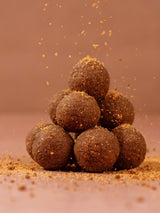
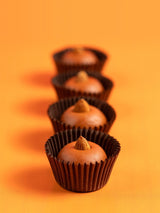
The Caramel Bites are the clearest argument for slow cooking. The caramel character they carry comes entirely from patient heat application. The same ingredients cooked quickly would produce a sweet that is merely sweet with some brown notes. Cooked slowly, the Maillard reactions and layered caramelisation of coconut sugar produce something that tastes earned.
The Sesame Pearls require the sugar base to reach a specific concentration before the sesame is folded in. Rushing the base means the sesame will not be held evenly in the matrix, producing uneven distribution and inconsistent texture. Slow cooking the base to the exact right stage is what allows the sesame to be incorporated cleanly and set into a pearl that holds together properly.
The Coconut Pearls demonstrate how slow cooking allows flavours to integrate rather than simply coexist. The coconut and the coconut sugar are cooked together until they are genuinely combined, not one mixed into the other at the end. This integration is only possible when the base has been cooked patiently enough that it can absorb the coconut without the mixture separating or losing its texture. The difference between integrated and merely combined is the difference between a good sweet and a memorable one.

