




Before Taste, There Is Touch
When you pick up a well-made sweet and take the first bite, the flavour does not arrive first. Texture does. The resistance of the outer surface, the way the sweet yields or holds its shape, the speed at which it begins to dissolve: all of this is registered by the mechanoreceptors in your mouth before the taste receptors have had time to fully process the flavour compounds. Your brain categorises the sweet as smooth or grainy, chewy or crumbly, dense or airy, before it begins to form an opinion about whether it tastes good.
This sequence matters because a poor texture can make an otherwise well-flavoured sweet feel disappointing, and an excellent texture can elevate a simpler flavour into something memorable. Confectioners who understand this do not treat texture as a secondary concern. They treat it as the foundation of the eating experience.

The Major Textures in Indian Sweets
Indian confectionery contains a remarkable range of textures, and each tradition has evolved specific techniques to achieve them. The smooth, dense fudginess of a well-made barfi or peda is one of the most satisfying textures in any sweet tradition. The sweet melts slowly, releasing flavour gradually, and leaves a clean finish. Achieving it requires cooking the sugar and milk solids to an exact stage and then working the mixture to develop the right structure without overworking it.
The crumbly texture of certain ladoos is a different kind of achievement. Rather than melting, these sweets break apart in a way that releases flavour quickly and completely. The structural matrix is designed to fracture predictably, not collapse or turn to powder. Ladoos that are too crumbly feel underworked; those that hold together too firmly feel stiff. The right texture exists in a narrow range and requires confident technique.
Chewier sweets like chikki and certain sugar-based confections require yet another set of skills. The chew comes from a specific ratio of crystalline and amorphous sugar, and that ratio is controlled by temperature, agitation, and timing during cooking. Too much chew becomes tough. Too little, and the sweet crumbles rather than stretches.

Why Artisanal Makers Control Texture Differently
Large-scale production lines standardise texture through precise machines, calibrated cooling tunnels, and the use of stabilisers and glucose syrups that prevent unwanted crystallisation. These tools produce reliable consistency, but they do it by reducing the natural variability that comes with real ingredients and manual technique. The texture is controlled, but it is also limited to what the machine can reliably reproduce.
Artisanal makers of handcrafted mithai work differently. They manage texture through judgement developed over batches, reading the consistency of a mixture by its behaviour on the pan or in their hands, not by a timer or a dial. Slight differences in ingredient moisture, ambient temperature, and even the rate of stirring; all influence the final texture. This is why small-batch artisanal sweets have a slight variation between pieces that is not a sign of inconsistency but of genuine human making.
Texture as a Quality Indicator
Experienced sweet-eaters use texture as a quality signal before conscious analysis begins. A well-made barfi has a distinct resistance when first bitten into, a slight give that transitions smoothly into a melt. Overcooked barfi forms large sugar crystals that feel grainy on the tongue. Undercooked barfi collapses rather than yields. The window for the correct texture is narrow, and landing in it consistently requires real skill.
Similarly, a high-quality marzipan-style sweet should be smooth and slightly firm without any graininess. The nut paste should be fine enough that individual particles are not detectable. When sugar crystallises at the wrong stage during making, even the finest nut paste cannot rescue the texture. And when the paste is coarse to begin with, no amount of correct sugar work can produce the smooth finish that signals quality.

The Role of Ingredients in Texture
Ingredients directly shape the textures available to a maker. Sugar type is the most obvious variable. Coconut sugar, when worked correctly, tends to produce a finer, more even crystalline structure than white sugar, which contributes to a smoother mouth-feel in set sweets. This is partly because of its multi-component sugar composition and partly because of the trace minerals and organic compounds that influence how crystals form.
Fat type matters enormously. Ghee creates a cleaner, crisper break in sweets compared to vegetable shortening, which produces a softer, more uniform texture that can feel slightly greasy. Milk solids from fresh whole milk bind differently from reconstituted milk powder, producing a structure that holds together more naturally. Nuts, whether whole or ground, whether freshly processed or pre-ground, contribute structural variation that either supports or disrupts the overall texture.

Three Sweets, Three Textures
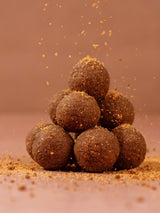
The Sesame Pearls offer a two-stage texture experience: a faint crispness from the outer sesame shell gives way to a denser, slightly yielding interior. This contrast is not accidental. It is the result of specific decisions about when the sesame is added and how the sugar has been cooked at that stage.
The Coconut Pearls are smooth and dense throughout, with the desiccated coconut integrated into the structure rather than sitting on the surface. The coconut does not create a grainy or fibrous texture; it adds a subtle variation within the smooth matrix.
The Cashew Marzipan is firm to the touch, smooth on the tongue, and finishes cleanly without sticking. Getting a marzipan to that point requires the correct sugar stage, correct nut grind, and the patience to work the mixture without overworking it. Each of these is a texture achievement before it is a flavour one. That is the point: in a well-made sweet, the texture creates the conditions in which the flavour can be experienced properly. They are not separate qualities. They are inseparable.

