





You Know It Before You Name It
There is a certain taste and texture that signals mass production before conscious analysis begins. It is the flavour profile that feels complete and slightly synthetic at the same time. The sweetness is present but flat. The texture is consistent but unremarkable. The sweet tastes like what it is: a product made to a spec, in a facility calibrated for volume. Most people can identify it without being able to articulate what gives it away. The recognition is sensory rather than analytical.
The question of what distinguishes a handcrafted sweet from one that was factory-made is not simply about premium versus standard. It is about the difference between a set of decisions made by a person with taste, judgement, and genuine care for the result, and a process optimised for consistency, cost, and scale.
What Mass Production Requires
Industrial sweet-making is built on standardisation. Every input must be consistent: the same sugar with the same moisture content, the same nut with the same fat percentage, the same flavour extract at the same concentration. This standardisation is necessary because the process cannot accommodate variable ingredients. A machine calibrated for one set of inputs produces errors when the inputs change.
The flavour implications of this are significant. Real ingredients, grown and processed without extreme standardisation, vary. Cashews from different harvests taste different. Fresh cardamom has aromatic compounds that ground commercial cardamom powder has largely lost. Coconut sugar from different batches has a slightly different flavour profile. These variations are not problems. They are signs that the ingredient is real. Mass production cannot use them, so it uses substitutes that do not vary: glucose syrup, artificial flavours, standardised spice extracts, stabilisers.

The Specific Markers of a Handmade Sweet
A handmade sweet made with real ingredients announces itself in several ways. The first is that the flavour builds rather than arrives all at once. Mass-produced flavours front-load their impact because artificial flavour compounds are designed to be immediately perceptible. Real flavours from real ingredients develop as the sweet is chewed and dissolves, revealing different compounds at different stages.
The second marker is finish. A well-made artisanal sweet leaves a specific, pleasant aftertaste: the residual flavour of good ghee, the lingering warmth of real cardamom, the faint caramel note of coconut sugar. Mass-produced sweets tend to leave either very little aftertaste or a slightly chemical one, because the flavour compounds that create a clean finish are exactly the ones that do not survive processing and have to be replaced with artificial versions.
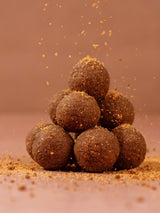
The third marker is slight imperfection. Handmade sweets have subtle variations between pieces: a shade of difference in colour, a minor variation in size, a slightly different distribution of nuts or sesame. These variations are not flaws. They are proof. They indicate that each piece was made by a person, not stamped out by a mould operating at a thousand pieces per hour.

The Role of No Refined Sugar
One of the most significant decisions in making a sweet that does not taste mass-produced is the choice of sweetener. Refined white sugar is the default choice for industrial confectionery for good reasons: it is inexpensive, neutral in flavour, consistent in composition, and entirely predictable in behaviour. Every advantage it offers to a large-scale producer is a reason an artisanal maker might choose something else.
A no refined sugar approach, using coconut sugar or jaggery instead, introduces ingredients with their own flavour into the foundation of the sweet. The caramel notes of coconut sugar are present in every bite, not as an added element but as the natural consequence of how the sugar was made. This is not something that can be faked. It cannot be replicated by adding caramel flavouring to a white sugar base. The difference is perceptible to any palate that has tasted both.
Preservative-Free Choices and What They Signal
The absence of preservatives in a sweet is both a functional choice and a quality statement. Artisanal makers of preservative-free Indian snacks are committing to a shorter shelf life and a more demanding production schedule. They are also committing to ingredients that do not need chemical assistance to behave themselves. Fresh nuts have a flavour that preserved nuts do not. Dairy prepared fresh has a cleanliness that shelf-stable alternatives cannot match. The absence of preservatives is a consequence of using real, fresh ingredients, not a separate decision imposed on top of them.

In the Range at The Coconut Sugar Company
The Nut Fusion Bites contain multiple types of nuts, each prepared to bring out its specific flavour. The variety means that no two pieces will taste exactly the same, because the distribution of nuts within each piece varies slightly. This is a feature of genuine handmade production. It is what a small batch made with real ingredients produces.
The Coconut Pearls are hand-shaped rather than moulded, which means each has a slightly different density and size. The coconut is incorporated by hand into the coconut sugar base, producing the integrated texture that distinguishes a handmade pearl from a commercial one. Browse the full artisanal sweets collection to see the range of what genuine small-batch, preservative-free production looks like when every choice is made for the sake of the sweet rather than the sake of the process.

